Viber
Viber
 Telegram
 WhatsApp

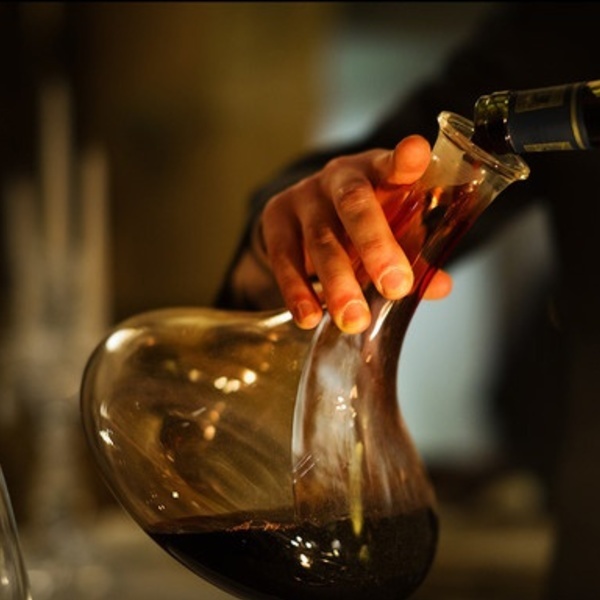
You've probably seen more than once how a sommelier pours wine from a bottle into a glass. mouseout:Nqw7Te; mouseover:E6Tfl,c2aHje" jsname="W297wb"> wine decanter. This procedure is called decanting and it is not just a custom for beautifully serving wine. Despite the fact that the process of decanting wine is generally simple, it has many nuances, which we will try to tell you about.
It should be noted that the choice - to decant or not - is always personal. Some prefer to enjoy the natural taste of wine, while others even decant champagne. However, sommeliers advise decanting primarily mature red wines, and not decanting pink and sparkling wines. Also, many experts do not advise decanting wines from the Grenache, Pinot Noir and Nebbiolo grape varieties. However, this can be argued.
Decanters as a gift

Historically, wine was always served in decanters, since bottles were absent in principle. Wine was shipped in barrels, and the drink was served on the table in elegant dishes.
Today, decanting has two purposes - to clear the wine of sediment that forms in the bottle, and aeration. The sediment not only looks unaesthetic in the glass, but also gives the wine bitterness and viscosity, and aeration, or saturation of the wine with oxygen, helps to reveal the wine bouquet. Previously, decanting was necessary for all wines, because the process of cleaning wine had not been invented.
Today, wines that are prone to aging are decanted: vintage ports and red wines of proven quality.
In inexpensive table wines, sediment formation is rather rare, because the wines are subjected to rigorous filtration. In order to check whether there is sediment in the bottle, it is necessary to leave it in a strictly vertical position for 24 hours, and then bring it up to the light and examine it.
If the purpose of decanting is to saturate it with oxygen, you should be careful not to spoil the wine. The action of oxygen can cause harm. The longer the wine is in contact with oxygen, the stronger the consequences of such an interaction: a diffused aroma, a less pronounced taste. Aeration is primarily necessary for young red wines that have not reached optimal maturity.

More complex and rich wines should be decanted a few hours before serving. To speed up this process, the contents of the bottle are poured into a wide-bottomed decanter. It is important to consider that prolonged aeration can be detrimental to some older wines. Aeration is also necessary for some aged white wines. In this case, the decanter is placed in a bucket of ice, leaving the wine chilled.
For proper decanting, the bottle must be kept upright for at least 24 hours before the procedure (if the wine has a lot of sediment, it is better to increase this period). Then you need to open the bottle and start pouring the wine into a carafe or decanter. It is important that the drink flows down the walls of the carafe, and does not immediately fall to the bottom. It is better to decant the wine in the light so that you can immediately notice as soon as the sediment begins to approach the neck of the bottle.

Before decanting, you need to pour a little wine into a glass and assess its quality. If the taste of the wine seems inferior to you, leave it for 5-7 minutes and repeat the procedure. If the bouquet has become fuller, most likely the wine needs additional aeration.
If you are in doubt whether the wine needs aeration, open the wine a few hours before serving, without pouring it anywhere. Thus, aeration will begin, but much less intensively.
Depending on the purpose of decanting, there are two categories of decanters. The first type is a carafe with a narrow high neck and a wide lower part. This vessel is intended for wines that require intensive aeration. For noble wines that do not require aeration, other decanters are used: elegantly shaped, with smooth contours, a narrow neck or lid.
Thanks to decanting, you can look at an already familiar wine from a new angle. Therefore, experiment and look for your own recipe: which wines, in your opinion, are worth decanting, and which are not.
After all, decanting is also a very beautiful ritual of serving wine. Why not adopt it from a sommelier and use it at home?